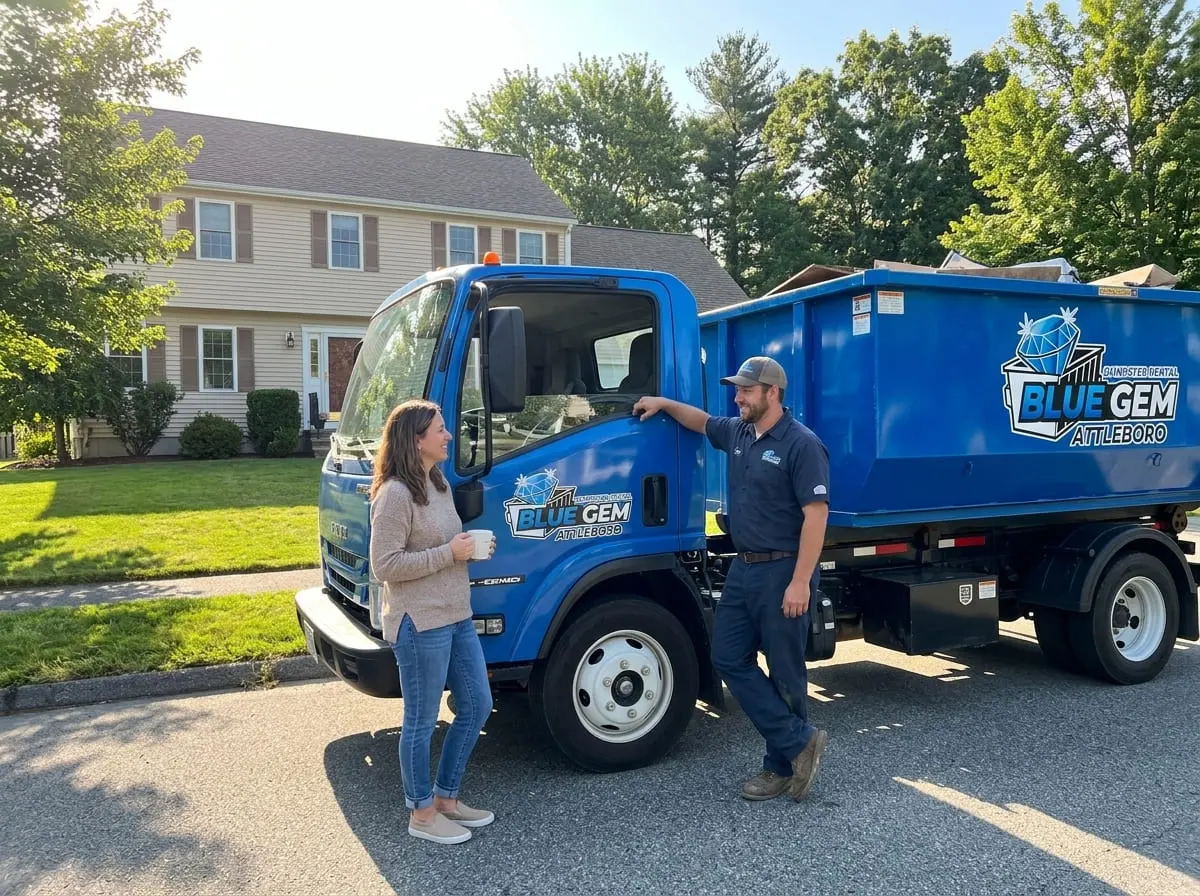
Renting a roll-off dumpster for a driveway cleanout, a roofing tear-off, or a basement gut is usually as simple as picking a size and a delivery date. But the moment a project moves from "load debris into a box" to "put a shovel in the ground," Massachusetts law adds a step that has nothing to do with your dumpster company and everything to do with what's buried under your yard: a call to Dig Safe.
Dig Safe is the official call-before-you-dig notification center for Massachusetts (and Maine, New Hampshire, Rhode Island, and Vermont). It is not a Blue Gem Dumpster Rental service, and it is not optional paperwork — it's state law, and it exists so a homeowner setting fence posts or a contractor trenching a drain line doesn't hit a gas line, an electric feed, or a water main. This guide walks through what Dig Safe actually requires, how it connects to a typical dumpster rental project in and around Attleboro, and when placing a dumpster on your driveway does not trigger any of it.
What Dig Safe Is (and Why It's the Law, Not a Suggestion)
Dig Safe System, Inc. is the nonprofit notification center that member utility companies use to mark the location of underground gas, electric, communications, water, and sewer lines before excavation work happens nearby. In Massachusetts, the requirement to call before you dig is written into Massachusetts General Law Chapter 82, Sections 40–40E (commonly called the Dig Safe Law) and detailed further in 220 CMR 99.00, the state's Dig Safe regulation. The law applies to homeowners doing a weekend project just as much as it applies to licensed excavation contractors — there's no DIY exemption.
You can reach Dig Safe two ways:
- Call 811 or 1-888-DIG-SAFE (1-888-344-7233) — the standard phone route, generally staffed weekdays, mornings through early evening
- Submit online through Dig Safe's Exactix ticketing system at digsafe.com
Either way, the request creates a "locate ticket." Dig Safe routes that ticket to every member utility with facilities in the area, and each utility is responsible for sending someone out to mark, or confirm there's nothing to mark, before your notice period expires.
The real-fact callout: 72 hours, not counting weekends
Massachusetts requires a minimum of 72 hours' advance notice before excavation can begin, and that clock explicitly excludes Saturdays, Sundays, and legal holidays. Call Dig Safe on a Thursday afternoon and your earliest legal start, in a normal week with no holiday in the mix, typically lands the following Tuesday — not Sunday. Once utilities mark the site, those markings are generally considered valid for about 30 days in Massachusetts; if paint or flags fade or get disturbed before you're done digging, the fix is another call to 811 for a remark, not a guess.
Does Ordering a Dumpster Actually Require a Dig Safe Call?
For most residential and commercial dumpster rentals, no. Setting a roll-off container on an existing paved driveway, a parking lot, or a street (with any needed local permit) doesn't disturb the ground, so it doesn't meet the legal definition of excavation. A residential cleanout dumpster, a 20-yard dumpster for a garage purge, or a junk removal container sitting on asphalt or concrete is placement, not digging, and Dig Safe's requirement is triggered by "disturbing the surface of the earth," which placement alone does not do.
Where this gets more nuanced is where the dumpster sits. If a driveway isn't available or long-term parking of a container on grass or unpaved ground is the plan, that's more of a property-access and potential permit question for your city or town than a Dig Safe question — the container's own footprint still isn't excavation. The distinction that actually matters legally is simple: are you moving earth, or just setting a box on top of it?
The Dumpster-Adjacent Work That Almost Always Requires a Call
Here's the catch — plenty of the projects that come with a dumpster rental absolutely do involve digging, even when the container itself just sits quietly on the driveway. If any of the following is part of your job, that part needs its own Dig Safe ticket, separate from anything to do with the container:
- Deck or shed footings — post holes and concrete footings go below grade, often deeper than most people expect
- Fence posts — even a straightforward backyard fence line means dozens of individual dig points
- Drainage and French drains — trenching around a foundation to fix water problems is textbook excavation
- Mailbox and post replacement — genuinely covered under the law's broad definition, even for something that small
- Demolition of a slab, patio, or small structure where footings or utility stubs are removed below the surface
- Landscaping that includes grading, tree removal with stump grinding, or new plantings deeper than a few inches
- Pool installation, in-ground or semi-in-ground, prepped alongside a 30-yard or 40-yard dumpster for excavated soil
A roofing tear-off booked with a roofing dumpster generally doesn't touch the ground at all and stays outside Dig Safe's scope. A full demolition project or a construction job that includes foundation work, new utility hookups, or grading almost always does. When a job blends both — say, a driveway dumpster for debris plus a contractor digging new footings a few feet away — the dumpster and the digging are two separate questions under two separate sets of rules, and only one of them involves Dig Safe.
What Gets Marked, and What the Colors Generally Mean
Once your ticket is in, each affected utility sends a locator to paint or flag its lines within your project area. Massachusetts utilities generally follow the same nationally recognized color code used across the country, so if you see stakes or spray paint on your lawn before a project, it typically breaks down roughly like this:
- Red — electric power lines and cables
- Yellow — gas, oil, and steam lines
- Orange — communications, cable TV, and fiber
- Blue — water lines
- Green — sewer and drain lines
- Pink — temporary survey markings
- White — the boundaries of where you told Dig Safe you plan to dig
That last one, white, is worth doing yourself before the locators even show up: pre-marking your planned dig area with white paint or flags (sometimes called "white-lining") helps utilities mark only what's relevant and speeds the whole process along. It's not required, but contractors who do a lot of excavation work around North Attleborough, Mansfield, Norton, and other towns in the area tend to do it as standard practice.
Penalties for Skipping the Call
Massachusetts doesn't treat this as a paperwork technicality. Under state law, hitting a gas facility after failing to obtain a valid locate ticket can carry penalties up into six figures per violation, and damage to other underground utilities (electric, water, communications) can bring fines that escalate for repeat violations within a 12-month span. Beyond the legal exposure, the practical risk is worse: a struck gas line, severed electric feed, or ruptured water main in the middle of a project can mean an evacuation, a multi-day utility outage for neighbors, and a repair bill that dwarfs whatever the digging job was supposed to cost in the first place. The 72-hour wait is genuinely inconvenient when you're eager to start — it's also the cheapest insurance policy available for the job.
Planning a Dumpster Delivery Around a Digging Project
For jobs that combine both — a dumpster for debris and actual excavation nearby — the smart order of operations is usually to call Dig Safe first, since that 72-hour, weekends-excluded clock is the longest lead time in the whole project. Booking the dumpster itself is far more flexible; Blue Gem Dumpster Rental offers same-day delivery in many cases once a date works for your site, so there's rarely a reason to let dumpster scheduling be the bottleneck. A rough planning sequence looks like:
- Call 811 or submit online at digsafe.com as soon as you know a project involves any digging
- Use the required waiting period to finalize project scope, order materials, and pick a dumpster size
- Schedule dumpster delivery for on or after the day your ticket clears, so the container and the marked work area are both ready at once
- Keep the container clear of any marked or flagged areas if digging and disposal are happening in the same yard
If you're not sure whether your specific project counts as excavation, the safest move is to call Dig Safe and ask — it costs nothing and the people answering the phone field that exact question constantly. For everything else on the dumpster side, from choosing between a 10-yard and a 15-yard dumpster to sorting out concrete and heavy debris rules, Blue Gem Dumpster Rental is reachable at (774) 300-3586, Monday through Saturday, 7:00 AM to 7:00 PM.
Frequently Asked Questions
See below.