Order the wrong dumpster and you find out the hard way — either a 40-yard container sitting mostly empty in your driveway for a week, or a 10-yard box that fills up on day one of a job you thought would take three. The right size almost always comes down to two things: how much room the debris takes up, and how much it weighs. For most homeowners and contractors working in and around Attleboro, the choice narrows to five practical options, and matching one to your project type is easier than it sounds once you know what typically fills each size.
Start With the Job, Not the Yardage
It's tempting to think bigger is always safer, but a dumpster rental is priced around a certain weight allowance as well as a certain footprint, so "just get the big one" can backfire if your debris is dense material like shingles, tile, or concrete. Two projects that look similar in square footage — say, a bathroom gut and a kitchen gut — can call for different sizes because one produces bulky-but-light debris (cabinets, drywall, old fixtures) and the other produces heavy, compact debris (tile, tub, subfloor). Think in terms of volume first, then sanity-check against weight, and you'll land on the right container far more often than guessing by room count alone.
The Five Dumpster Sizes at a Glance
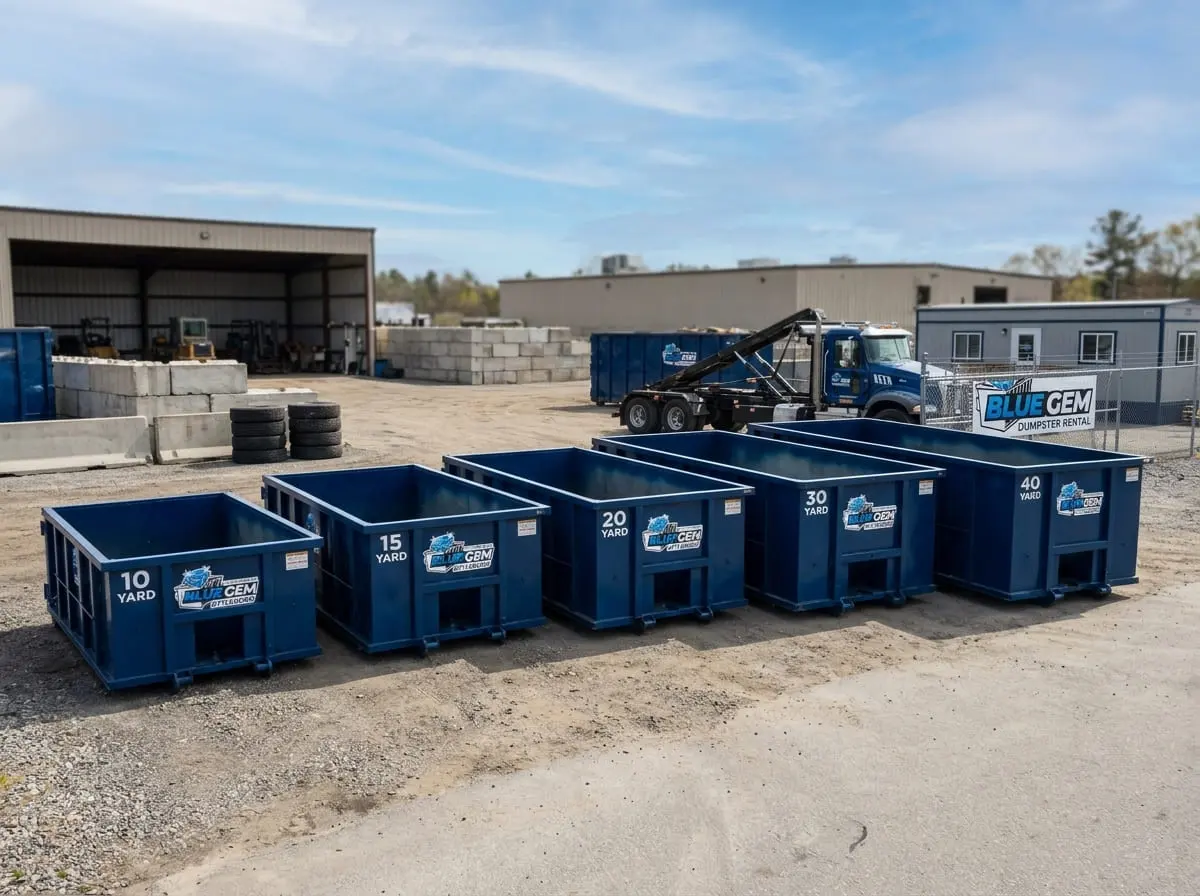
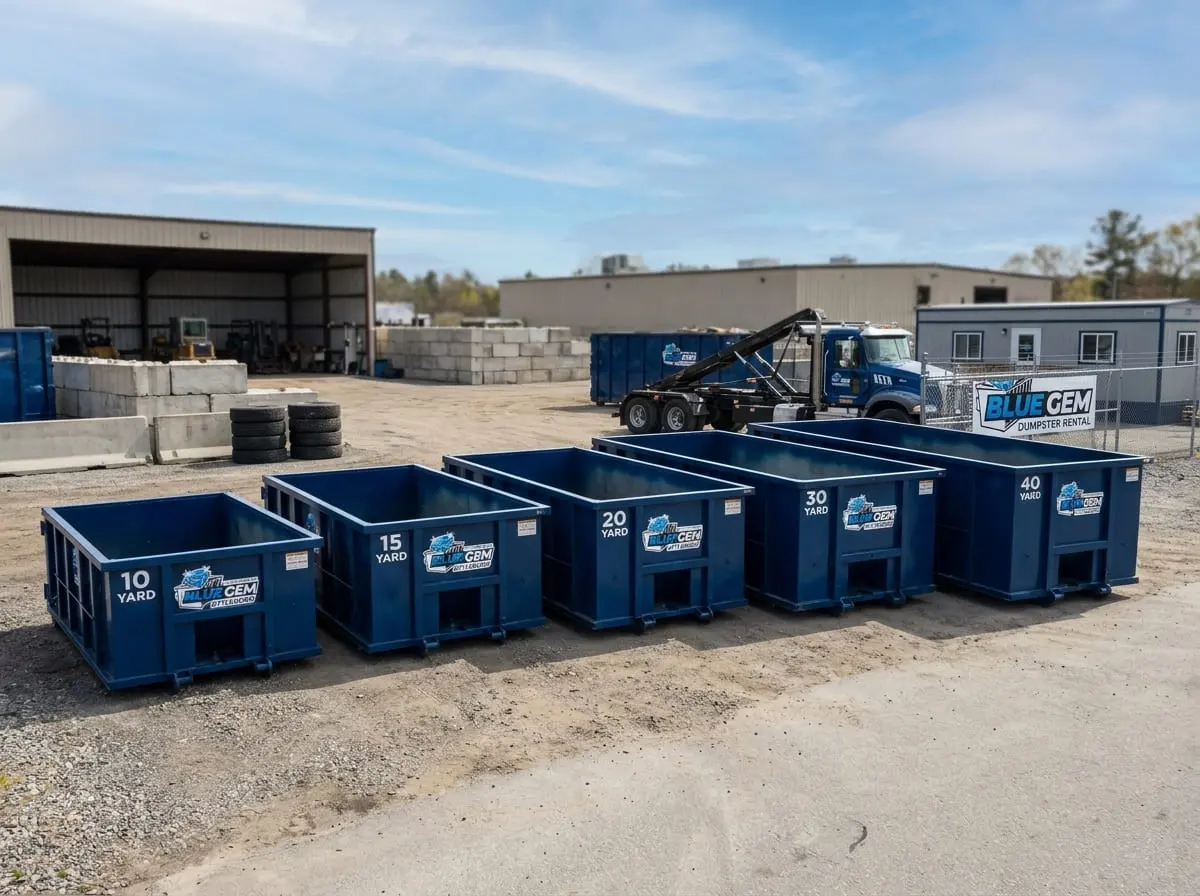
Blue Gem runs five roll-off sizes out of our Attleboro yard, and each one tends to suit a different scale of project. These are typical dimensions and typical capacities — your particular haul may run lighter or heavier depending on what's actually in the pile.
The "truck loads" column is a rough way to picture volume — it's roughly how many full pickup-truck beds it would take to move the same amount of debris. It's a helpful gut check when you're standing in a garage or basement trying to estimate what you're actually dealing with.
Matching Dumpster Size to Common Attleboro Projects
Every job is a little different, but after years of residential and construction deliveries around Bristol County, some patterns hold up consistently. Here's how we typically size the most common project types.
Bathroom Remodel
A single full bathroom gut — vanity, toilet, tub or shower surround, tile, and a bit of drywall — is usually a 10 yard dumpster job, sometimes stretching to a 15 yard if the tub is cast iron or there's a lot of tile and mortar involved. Tile and old cast-iron fixtures are dense, so weight can catch up with you faster than volume does on a bathroom job.
Kitchen Remodel
Kitchens generate more bulk than weight — cabinets, countertops, appliances, and flooring add up in volume quickly even when the material itself isn't especially heavy (unless you're pulling out stone countertops, which shifts things toward the heavier end). Most kitchen remodels land comfortably in a 15 yard, with larger kitchens or combined kitchen-and-adjacent-room projects moving up to a 20 yard.
Garage, Basement, or Attic Cleanout
Cleanouts are mostly a volume question, since a lot of what comes out of a garage or attic is boxes, furniture, and general accumulation rather than dense construction debris. A single-car garage or small basement usually fits a 10 or 15 yard. A packed two-car garage or a combined garage-and-attic cleanout often calls for a 20 yard. For lighter loads of household junk without renovation debris mixed in, our junk removal service can sometimes be a better fit than a full roll-off.
Roof Tear-Off
Shingles are deceptively heavy — a single layer of asphalt shingles off an average-sized roof can weigh several tons on its own, and many older Attleboro homes have two or even three layers stacked from past re-roofs. This is the project type where weight, not size, is usually the limiting factor. A typical single-layer tear-off on a mid-sized roof often works in a 20 yard, but a multi-layer tear-off or a larger roof frequently needs a 30 yard specifically for the weight allowance, even though the shingles wouldn't fill a 30 yard container by volume. Talk through your roof's square footage and layer count with our roofing team before you order — it's the single biggest factor in getting the size right.
Whole-Home Renovation or Addition
Gutting multiple rooms, an addition, or a full interior renovation typically produces a steady stream of mixed debris — framing, drywall, flooring, old cabinetry, fixtures — over the course of the job. Many of these projects use a 20 or 30 yard container, sometimes with a swap-out partway through if debris piles up faster than expected. Our construction and roll-off services are set up for exactly this kind of ongoing-job scheduling.
Estate Cleanout or Downsizing
Clearing out a full house — furniture, appliances, decades of belongings, sometimes a shed or garage on top of it — is almost always a volume-driven project rather than a weight-driven one. A modest single-family home cleanout often needs a 20 yard, while a larger home or one with an unusually full basement, attic, and garage can push into 30 yard territory. Because estate cleanouts often come with a tight emotional timeline as well as a practical one, our estate cleanout service is built around flexible scheduling and straightforward drop-off and pickup.
Yard Waste and Landscaping Projects
Brush clearing, tree removal, sod tear-out, or a landscape overhaul is usually light by weight but can take up real room, especially with branches and root balls. A 10 or 15 yard handles most single-tree or small yard cleanups; larger lot-clearing jobs move up from there. See our yard waste page for what's accepted.
Demolition and Concrete or Heavy Debris
Concrete, brick, block, asphalt, and similar heavy materials are the clearest example of weight outrunning volume — a container that looks half-empty can already be at its weight limit. Small concrete jobs (a walkway, a small patio slab) often fit in a 10 yard specifically because of weight, not because the material wouldn't fit in something bigger. For structural demolition or larger concrete removal, it's worth a call so we can match the container to both the volume and the weight realistically — our demolition debris and concrete & heavy debris teams handle this sizing conversation daily.
Why Weight Limits Matter as Much as Cubic Yards
Every dumpster rental typically includes a set weight allowance, and going over it usually means an added fee based on the excess tonnage. This is why two jobs that look the same size on paper — drywall and insulation versus tile and concrete — can call for different-sized containers. Rough rule of thumb: if your project involves shingles, tile, concrete, brick, dirt, or plaster, lean toward sizing up or asking about the weight allowance before you order. If it's mostly furniture, cabinetry, drywall, or general household bulk, volume is the bigger constraint and you have more room to judge by eye.
Local Factors That Affect Sizing in Attleboro
Attleboro's housing stock includes many homes built well before mid-century, often with plaster-and-lath walls, old slate or multi-layer roofs, and full basements — all of which tend to add weight to a renovation or cleanout compared to a newer build. Driveway and street access matters too: a 40 yard container needs meaningfully more clearance than a 10 or 15 yard, worth considering on tighter lots in older, denser parts of the city.
Local note: Attleboro earned its historical nickname "The Jewelry City" from more than a century of manufacturing by firms like L.G. Balfour Company and D.E. Makepeace — heritage you can still see today at the Attleboro Area Industrial Museum and along the L.G. Balfour Riverwalk on the Ten Mile River. A lot of the older homes we service near that same manufacturing-era core come with the plaster, lath, and layered-roof quirks mentioned above, which is one more reason it's worth a quick conversation before locking in a size.
When in Doubt, Ask Before You Order
If your project doesn't map neatly onto one of the categories above, or you're weighing two sizes and not sure which way to go, it's genuinely faster and cheaper to ask first than to swap containers mid-job. Blue Gem Dumpster Rental is owned and run by Ryan Fontaine out of our yard at 42 Frank Mossberg Dr in Attleboro, and after years of sizing jobs across North Attleborough, Mansfield, Seekonk, and the surrounding towns, our team can usually get you to the right size with a short phone conversation about the project. We're open Monday through Saturday, 7:00am to 7:00pm, and same-day delivery is often available if your timeline is tight — see our same-day service for details. Call (774) 300-3586 and describe what you're clearing out; we'll help you land on a size that fits both the job and the budget the first time.