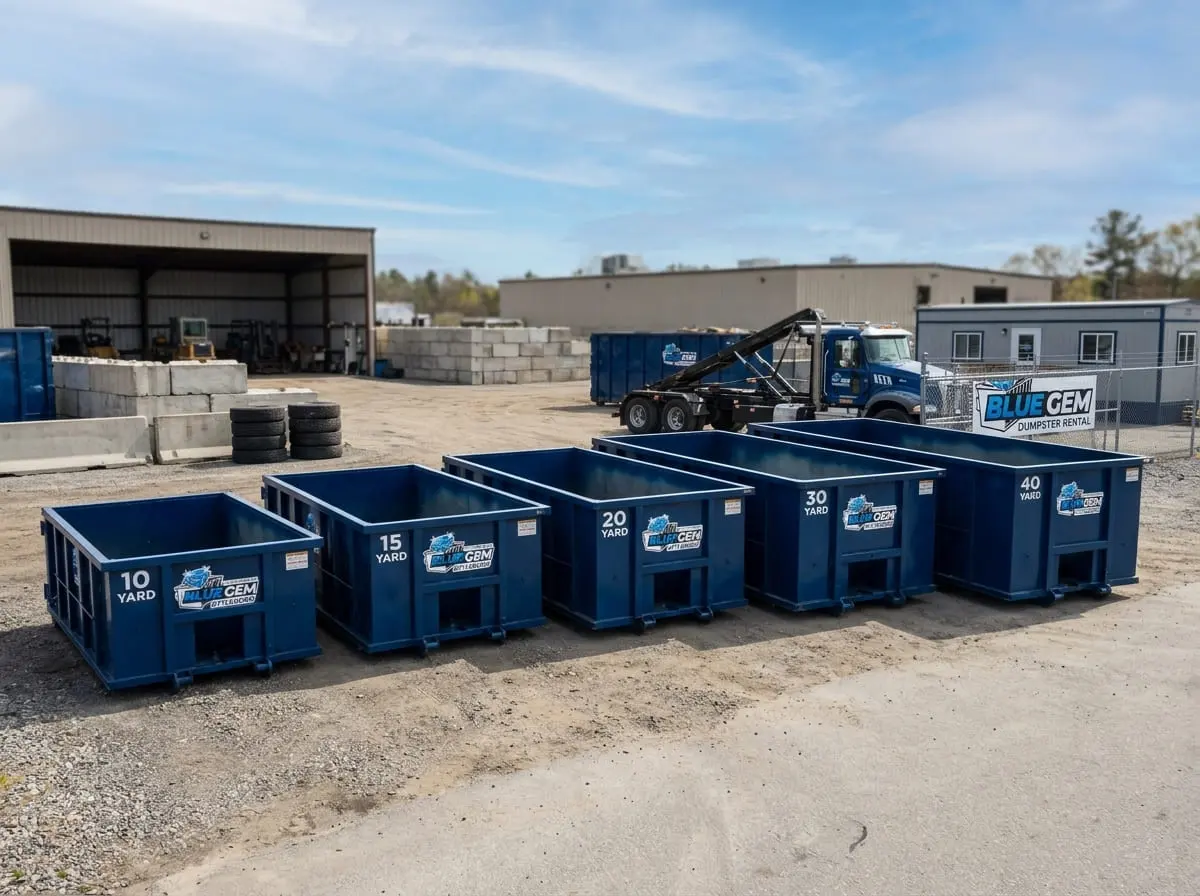
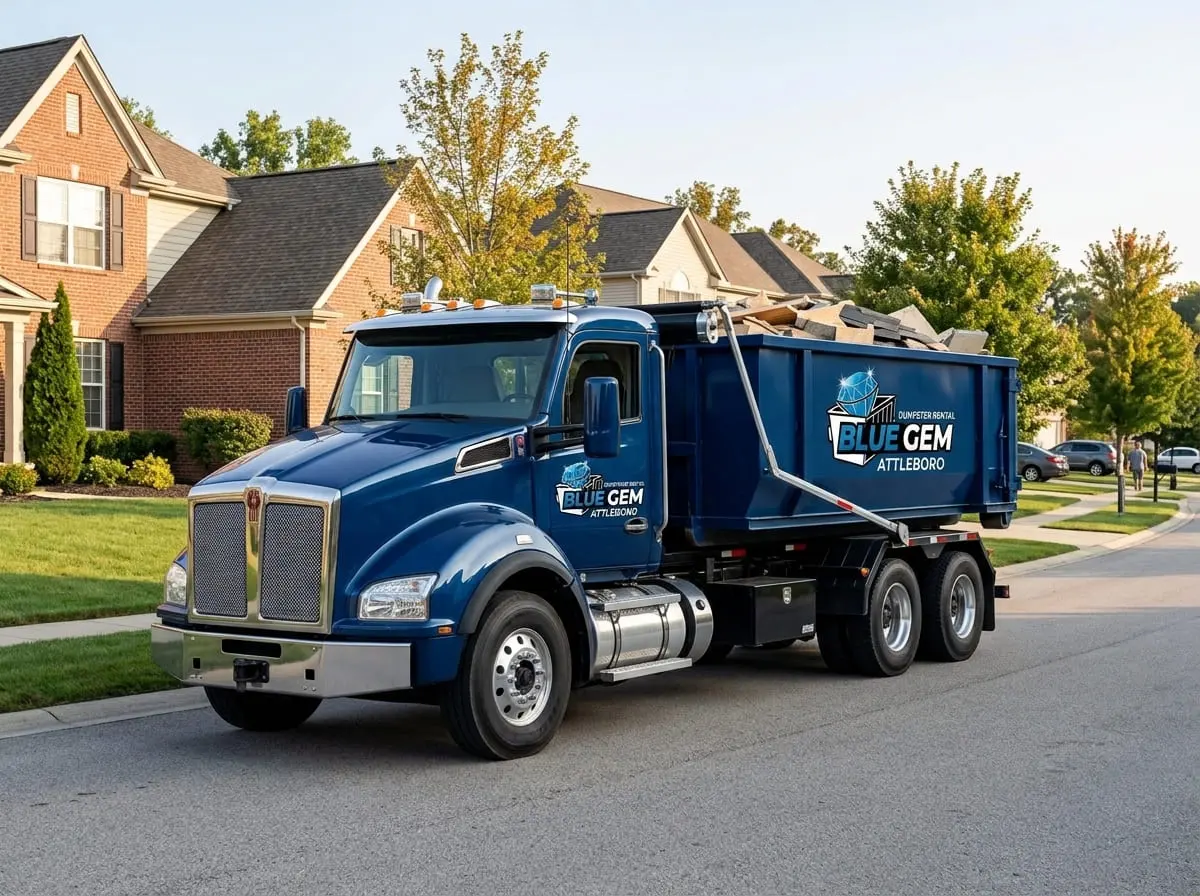
One of the most common questions Ryan Fontaine hears at Blue Gem Dumpster Rental is some version of "what size do I actually need?" There's no single answer, because a garage cleanout and a roof tear-off fill a container in completely different ways — one is bulky and light, the other is dense and heavy. Rather than hand you a generic size chart, it helps to walk through how the reasoning actually works, project by project.
The scenarios below are illustrative, typical-case examples built from jobs that come up again and again around North Attleborough, Mansfield, Norton, Seekonk, and Plainville — not accounts of specific past customers. Think of them as "here's how the thinking usually goes," so you can apply the same logic to your own project. For a project-specific recommendation, a quick call to (774) 300-3586 during business hours (Mon–Sat, 7am–7pm) is still the fastest way to get it right.
A lot of homeowners try to estimate dumpster size the way they'd estimate mulch — by area. That works for yard waste, but it breaks down fast for demolition and remodeling debris, because weight and density matter as much as volume. A 20-yard container full of drywall dust and old shingles can hit its weight limit long before it looks "full." That same 20-yard box could just as easily swallow an entire garage's worth of bulky, lightweight junk with room to spare. The examples below walk through both sides of that equation.
Example: a kitchen remodel in an Attleboro two-family
Picture a typical kitchen remodel in an Attleboro two-family home — cabinets pulled out, old countertops broken up, a layer of vinyl flooring torn up, and a run of drywall replaced around new plumbing. It's a mid-size, single-room gut, not a whole-house renovation.
The reasoning
Cabinets and countertops are bulky but not especially heavy on their own. Drywall and old flooring add real weight, but the footprint of a single kitchen keeps the total volume modest. A 10-yard dumpster is often enough for a smaller galley kitchen with minimal structural work, while a 15-yard dumpster tends to be the safer call once full cabinet runs, a tile backsplash, and subfloor are coming out too. If the job stays contained to one room, the 10-15 yard range typically covers it; a larger kitchen-plus-adjacent-room project sometimes calls for a 20-yard dumpster to avoid a second haul-away.
This kind of job usually falls under residential dumpster rental, and because kitchen timelines tend to be tight, homeowners often ask about same-day delivery so the container is ready before demo starts.
Example: a garage cleanout in Mansfield
Now picture the opposite kind of job: a detached garage in Mansfield that's become a catch-all for decades of household overflow — old furniture, boxes of miscellaneous stuff, a broken lawnmower, some scrap wood, and general clutter that's been pushed to the back wall for years.
The reasoning
Garage cleanouts are almost always a volume problem, not a weight problem. The material is bulky and irregularly shaped — furniture, bins, sports equipment — but rarely dense. That's exactly the scenario where a 15-yard dumpster earns its keep: enough cubic capacity to swallow odd-shaped items, but still compact enough for a driveway. A one-car garage that's lightly cluttered might get by with a 10-yard dumpster, while a two-car garage packed floor to ceiling — or a cleanout that also includes a shed or basement — often pushes toward a 20-yard dumpster instead. The general logic: estimate how full the space looks, then size up one notch, since bulky household junk almost always takes up more container space loaded loosely than it would stacked perfectly.
Jobs like this typically fall under general junk removal or straightforward residential rental, depending on whether you're loading it yourself or want help.
Example: a roof tear-off in Norton
Here's where the weight-versus-volume distinction really matters. Take a typical single-family roof tear-off in Norton — a moderate-size ranch or cape getting one or two layers of asphalt shingles stripped down to the deck.
The reasoning
Shingles are dense. A pile of torn-off asphalt shingles that looks modest in a driveway can weigh far more than the same volume of household junk. This is the classic case where sizing by "how much space will it take up" leads people astray — the container might look half-empty and still be near its practical weight limit. For a single-layer tear-off on an average-size roof, a 15-yard dumpster is often sufficient, but many roofing contractors default to a 20-yard dumpster as a safer baseline, especially with two layers of shingles or a larger roof with dormers and multiple planes. Because of the weight factor, it pays to describe the roof size and shingle layers when you call — a size that's roomy enough by volume can still be the wrong choice if it can't handle the tonnage.
This is squarely roofing debris territory, and it overlaps with general construction debris rules around weight limits — worth a quick conversation before delivery rather than a guess.
Example: a full estate clearance in Seekonk
Consider a full estate clearance in Seekonk — an entire single-family home being emptied out room by room: furniture throughout the house, a full basement, an attic, a garage, and years of accumulated belongings.
The reasoning
Estate clearances combine the volume challenge of a garage cleanout with the scale of an entire house rather than one room. That combination usually points toward a 30-yard dumpster as the typical starting point, since it needs to absorb furniture from every room plus whatever's stored in the basement and attic. A smaller home, or one where usable items are being donated or sold off first, might only need a 20-yard dumpster. On the larger end — a bigger house, a detached garage full of tools, or decades of accumulation — some clearances step up to a 40-yard dumpster, particularly to finish the whole job in one container rather than swapping mid-project.
Because timing often matters for families managing a property on a deadline, this is a case where it's worth discussing both the estate cleanout service and general roll-off logistics — how long the container can stay on-site, and whether a swap-out is realistic if the first size runs short.
Example: a small commercial fit-out in Plainville
Last, picture a small commercial fit-out in Plainville — a storefront or small office space being gutted and rebuilt for a new tenant: old flooring, dropped ceiling tile, some interior partition walls, and outdated fixtures coming out ahead of new construction.
The reasoning
Commercial fit-outs sit in a middle ground. There's more total material than a residential remodel, but it's usually not as dense as a roof tear-off unless masonry or concrete is involved. For a small storefront or office suite, a 20-yard dumpster is a common starting point, covering flooring, ceiling tile, drywall, and fixtures without excess. Larger buildouts — more square footage, more partition demolition, or old cabinetry and millwork — often move up to a 30-yard dumpster. Commercial timelines also tend to be less flexible, since every day mid-construction is a day the space isn't generating revenue, which is another reason contractors often prefer to size up rather than risk a mid-project swap.
This category generally falls under commercial dumpster rental, sometimes alongside general construction debris removal depending on what's coming out of the space.
The general pattern across all five examples
Looking at these five scenarios together, a pattern emerges. Ask two questions before landing on a size: how much physical space will the debris take up, and how heavy is the material per cubic yard? Bulky-but-light jobs — garage cleanouts, estate clearances, most commercial demo — tend to be volume-limited, so it's reasonable to size up when the space "looks full." Dense jobs — roofing, concrete, heavy renovation debris — tend to be weight-limited, so the container can hit its limit well before it looks full, and the safer move is often to size up rather than guess. Timeline matters too: a one-room remodel wraps in days and can lean smaller, while a whole-house clearance or commercial buildout benefits from a bigger container up front to avoid a mid-project swap.
When in doubt, describe the project rather than guess the size
None of these examples are a rigid formula — every property, basement, and roof pitch is a little different. The fastest way to get a reliable size recommendation is to describe the actual project: the rooms or areas involved, roughly how full the space looks, and whether the debris is more like furniture and boxes or more like shingles and drywall. Ryan and the team at Blue Gem Dumpster Rental field these conversations regularly across Rehoboth, Foxborough, Wrentham, and the rest of the greater Attleboro area, and a quick call to (774) 300-3586 during business hours (Mon–Sat, 7am–7pm) usually settles the question faster than a size chart alone.